Beyond Prediction: Why Explainable AI and Causal AI Outclass "Good Enough" Machine Learning

CloudExplain Team
December 19, 2024 · 12 min read
When machine learning first entered the corporate toolkit, the breakthrough was prediction. If you could forecast next week's churn rate or spot a fraudulent transaction ten milliseconds before it cleared, you already felt ahead of the game. A decade on, the bar has risen. Most teams can spin up a logistic regression model in scikit-learn before the first coffee break. Even gradient boosting and deep learning libraries come with one-line demos.
Why, then, is it that so many "working" models stall once they leave the lab? The answer is that accuracy alone is not the destination—it is the entry ticket. To change outcomes in the real world you must do three additional things: show people how the model reached its conclusion, reveal what truly drives those conclusions, and allow decision-makers to rehearse different actions before they commit.
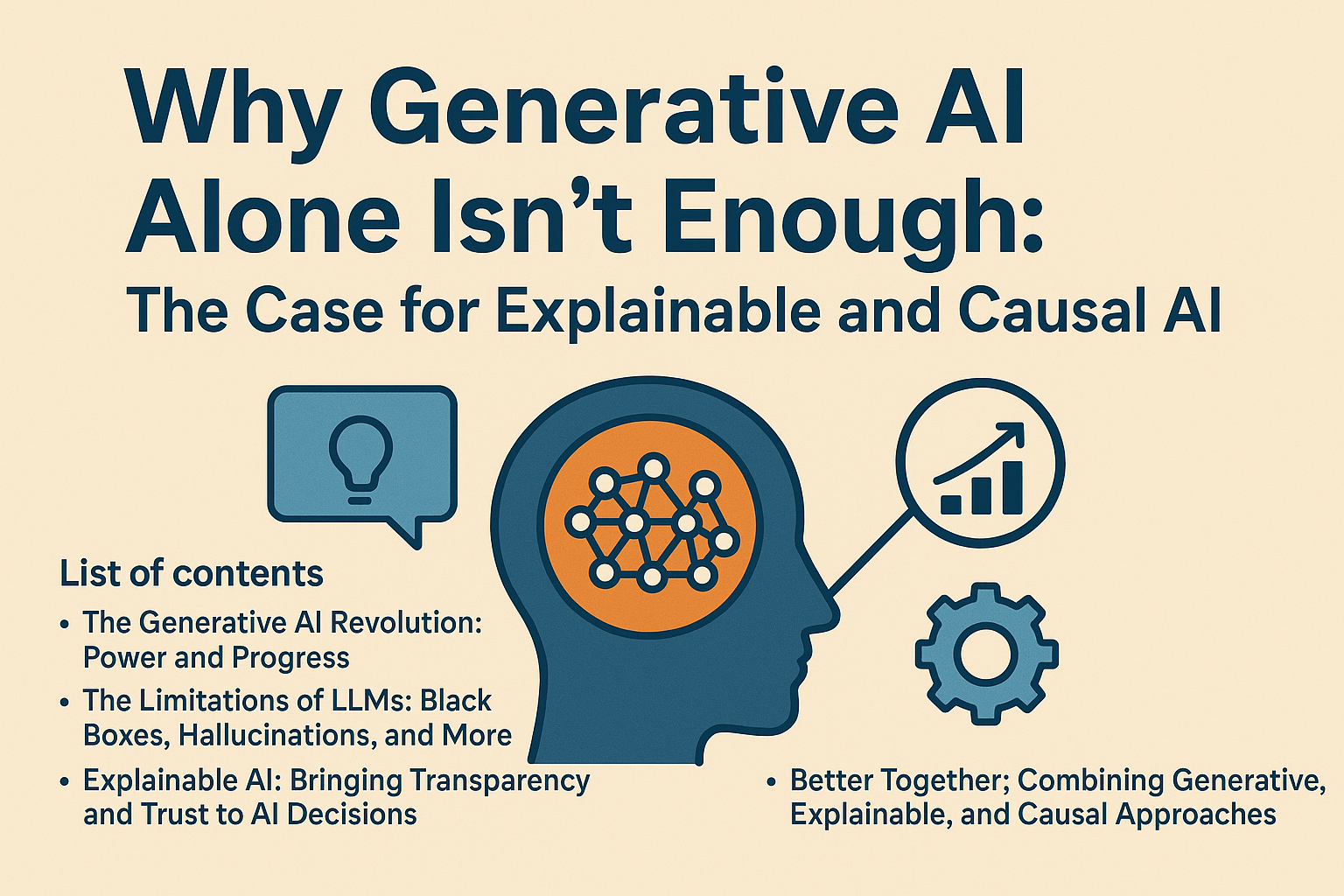
That is the territory of Explainable AI and Causal AI – and it is where the genuine competitive advantage now lies. Read more details below what it means for companies and how this can be implemented.
Table of Contents
1. The Limits of Simple, Transparent Models
Suppose your data science team has built a churn risk score with ordinary logistic regression. The coefficients are easy to read: a high support ticket count increases churn odds, a recent purchase reduces them. For many firms that visibility is comforting, but two structural problems appear the moment the model meets complexity.
First, linear models flatten nuance. They assume every extra support ticket adds the same incremental churn risk, regardless of whether the customer is on a high-value tier or received a retention voucher two days ago. Real behaviour is rarely so tidy. Interactions – support tickets × tenure × price sensitivity – drive churn in tangled ways that simple equations cannot capture. The immediate consequence is an accuracy ceiling: as data richness grows, performance plateaus.
Second, the path from "who will churn" to "why and how do we keep them" remains murky. A coefficient tells you the average effect of a variable but not how that variable combines with dozens of others to change an individual's decision. So retention teams default to blunt tactics – blanket discounts, generic winback emails – and complain that data science never speaks their language.
Many organisations accept these tradeoffs because they fear the alternative: complex "black-box" models no one can explain. That fear is valid – but Explainable AI exists precisely to dissolve it.
2. Explainable AI: Turning Black Boxes into Insights
Modern ensembles and deep networks win predictive competitions because they model non-linearities, handle thousands of inputs, and adapt to subtle pattern drift. Yet until recently, they produced outputs fit only for data scientists. Explainable AI has changed the landscape.
Techniques such as SHAP quantify the contribution of each feature to a single prediction, local counterfactuals show which minimal change flips a decision, and influence functions trace a misclassification back to the training data that taught it. These are not academic curiosities. They are the difference between a recommendation engine a merchandiser will trust or ignore.
Imagine you run a call centre and a gradient-boost model flags Customer 23761 as high churn risk. Without explanation, your agent sees only a red risk flag. With SHAP, the dashboard flashes the top contributors: "Long wait time last two calls, price plan mismatch, new competitor offer detected." Instantly, the agent knows which lever to pull – a loyalty voucher is pointless if the real friction is queue length. Multiply that clarity by thousands of interactions and the compound impact dwarfs the marginal lift in model accuracy.
Explainability does more than guide frontline staff. Risk officers use it to audit fairness ("Are we penalising a protected group?"), regulators demand it to satisfy transparency clauses in the EU AI Act, and executives rely on it to justify strategic decisions to boards. In other words, explanations are now table stakes for deploying powerful models in any high-stakes environment.
3. Causal AI: From Correlation to "What Happens If…"
Even perfect explanations of correlations leave a final question unanswered: what will move the needle? A churn model may highlight that long wait times coincide with customer exits, but will hiring more agents actually reduce attrition, or is wait time only the symptom of deeper dissatisfaction? Traditional A/B tests answer such questions, but they are slow, expensive, and sometimes impossible. Causal AI offers a faster, less costly, and often more ethical route.
Causal methods start by mapping the web of cause and effect – through domain knowledge, statistical tests, or a blend of both – then estimate the impact of hypothetical interventions. They tell you: if we reduce wait time by two minutes, churn drops by 7 percent, holding other variables constant. If we raise subscription fees by five dollars, revenue climbs but churn jumps disproportionately for the student segment. You no longer act on hunches. You perform surgery with quantified foresight.
The power scenario emerges when causal inference meets complex, explainable models. The model surfaces subtle patterns, the causal layer distinguishes genuine levers from mere correlations, and the explanation layer translates both into human prose and visuals. Suddenly, the business can simulate strategy, not just score behavior. Marketing can price test a thousand microsegments within hours. Operations can experiment with process settings virtually before touching the line. Compliance can trace every automated decision back to its causal rationale.
Real-World Applications: Where XAI + Causal AI Deliver Impact
The convergence of explainable and causal AI creates transformative opportunities across industries:
- Financial Services: Credit decisions require both accuracy and auditability. Explainable models show loan officers why an application was flagged, while causal analysis reveals which interventions (income verification, co-signer requirements) actually reduce default risk versus those that merely correlate with good outcomes.
- Healthcare: Diagnostic AI must earn clinician trust through transparency. When a model flags a patient for sepsis risk, doctors need to see which vital signs and lab values drove the prediction. Causal analysis then helps determine which treatments will most effectively reduce that risk.
- Manufacturing: Production optimization depends on understanding complex interactions between machine settings, environmental conditions, and quality outcomes. Explainable AI identifies the key factors affecting yield, while causal models predict which adjustments will deliver the greatest improvements.
- Marketing: Customer segmentation models become actionable when marketers understand not just who is likely to respond, but why they respond and which interventions will change their behavior. Causal inference enables virtual testing of campaigns before expensive rollouts.
4. When Simplicity Breaks – and XAI + CAI Win
There remain domains where transparent models suffice: small tabular datasets with linear relationships, clear-cut business rules, or low-stakes decisions. But the number of corners where those constraints hold is shrinking. Data volume explodes, regulatory scrutiny intensifies, and competitive margins are thin.
In banking, regulators now require both accuracy and auditability for credit decisions. In healthcare, clinicians demand algorithmic second opinions – but only if they can understand them. Manufacturers chase single-digit yield gains that hinge on complex interactions among hundreds of machine parameters.
In each of these arenas, the choice is no longer simple vs. black box; it is simple and stagnant vs. complex and transparent. Explainable AI removes the risk from powerful models and Causal AI converts insight into counterfactual strategy. The duo is not an academic upgrade. It is the price of admission to the next phase of data-driven advantage.
5. What CloudExplain Adds
Building explainability and causal engines from scratch is non-trivial. Open-source libraries exist, but scaling them across millions of predictions, integrating outputs into dashboards, logging them for audit, and rendering them intelligible to non-scientists takes months of specialised engineering.
CloudExplain collapses that overhead into a few lines of code. Whatever model you run (e.g. scikit-learn, XGBoost, TensorFlow), we stream industrial-grade explanations and causal what-if analysis back to your environment, at cloud speed, with governance built-in.
The point is not to replace your models. It is to unlock their real value – trust, clarity, and targeted action – without forcing you to downgrade to oversimplified approaches or stall deployments in compliance limbo. As algorithms themselves commoditise, that interpretability and decision-intelligence layer becomes the enduring moat.
6. Conclusion
Prediction was yesterday's differentiator. Today, the edge belongs to those who can explain and shape outcomes, not simply anticipate them. Simple models offer comfort until complexity overwhelms them; black-box models offer power until opacity alienates stakeholders.
Explainable AI widens the usable accuracy frontier by translating black-box reasoning into plain language. Causal AI pushes beyond observation into prescription. Together they transform machine learning from a statistical exercise into a powerful decision engine.
In that future – already arriving in credit scoring, marketing retention, manufacturing optimization, and healthcare triage – organisations will not ask "What does the model predict?", but "What is the model telling us to do, and why?"
Those who can answer confidently will outpace those who still trust a silent algorithm or a simplistic regression. That is why CloudExplain exists: to make the sophisticated transparent, the complex actionable, and the merely accurate truly impactful.
Key Takeaways
- Accuracy is Just the Entry Ticket: Modern AI success requires explanation, causation, and actionable insights
- Simple Models Hit Limits: Linear models cannot capture complex interactions that drive real-world behavior
- Explainable AI Bridges the Gap: SHAP, counterfactuals, and other techniques make complex models interpretable
- Causal AI Enables Strategy: Understanding cause-and-effect allows simulation of interventions before implementation
- Combined Power: XAI + Causal AI transform ML from prediction tools into strategic decision engines
References and Further Reading
Core Concepts:
- Lundberg, S. M., & Lee, S. I. (2017). A unified approach to interpreting model predictions. NIPS.
- Pearl, J. (2009). Causality: Models, Reasoning and Inference. Cambridge University Press.
- Molnar, C. (2020). Interpretable Machine Learning. Available online.
Industry Applications:
- EU AI Act requirements for explainable AI in high-risk applications
- FDA guidance on AI/ML-based medical device development
- Banking regulations on algorithmic transparency (e.g., GDPR Article 22)
Technical Implementation:
- SHAP library documentation and case studies
- DoWhy causal inference library
- LIME (Local Interpretable Model-agnostic Explanations)